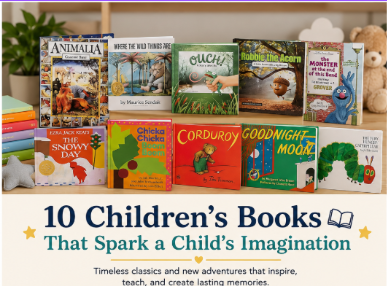
There are children's books we read once—and then there are the books that somehow become part of childhood.
They're the stories children ask to hear again and again. They're the books parents can practically recite from memory. And years later, just seeing the cover can bring back memories of bedtime, a favorite reading chair, or a little voice asking, “Can we read it one more time?”
At 8 Waves Media, we love children's stories that do more than fill a few minutes before bedtime. We love books that encourage imagination, introduce children to wonderful characters, make them laugh, help them understand their feelings, or simply make reading together fun.
Here are ten children's books we think deserve a place on the bookshelf.
Find these books on Amazon: https://amzn.to/4qOEeAn
Affiliate Disclosure: As an Amazon Associate I earn from qualifying purchases. Some links in this article are affiliate links, which means 8 Waves Media may earn a commission from qualifying purchases at no additional cost to you.
1. Animalia — Graeme Base
Animalia is the kind of book children can explore over and over and still discover something new. Each incredibly detailed illustration is packed with animals, objects, and surprises corresponding to a different letter of the alphabet.
It's part alphabet book, part seek-and-find adventure, and part work of art. This is a wonderful choice for children who love spotting tiny details—and for parents who enjoy discovering things right alongside them.
Why we love it: It turns learning the alphabet into an imaginative visual adventure.
2. Where the Wild Things Are — Maurice Sendak
Few children's books capture the enormous emotions of a small child quite like Where the Wild Things Are.
Max's journey from his bedroom to the land of the Wild Things gives children permission to explore anger, independence, imagination, and ultimately the comfort of returning home.
And, of course, there's always time for a wild rumpus.
Why we love it: A remarkably simple story that understands just how big childhood emotions can feel.
3. Ouch! A Cautionary Tale - Amy Donahue, Published by 8 Waves Media
Sometimes learning to be gentle takes a little practice.
Ouch! uses storytelling to help young children understand how their actions can affect others, introducing an important social-emotional lesson in a way that's approachable for little readers.
Why we love it: Stories can be powerful tools for teaching kindness, empathy, and gentle behavior without making the lesson feel like a lecture.
4. Robbie the Acorn - Ken & Amy Donahue, Published by 8 Waves Media
What can a little acorn become?
Robbie the Acorn celebrates growth, possibility, and the idea that even the smallest among us can have an important journey ahead.
It's exactly the kind of message we love sharing with young children: you don't have to be big to have big possibilities.
Why we love it: Robbie gives parents an opportunity to talk with children about growing, believing in themselves, and discovering who they can become.
5. The Monster at the End of This Book
Grover desperately does not want you to reach the end of this book.
Naturally, that makes turning the page irresistible.
With every page, Grover comes up with increasingly ridiculous ways to stop the reader from moving forward—all because he's terrified of the monster waiting at the end.
We won't spoil the surprise.
Why we love it: It's funny, interactive, and practically begs children to participate in the story.
6. The Snowy Day — Ezra Jack Keats
Sometimes the best childhood adventures are the simplest ones.
Peter wakes up to discover that his neighborhood has been transformed by snow and heads outside to explore it. Footprints, snow angels, snowy trees and all the little discoveries of a winter day become an adventure.
Why we love it:The Snowy Day captures something children's books sometimes overlook—the extraordinary wonder children can find in ordinary experiences.
7. Chicka Chicka Boom Boom — Bill Martin Jr. & John Archambault
“A told B, and B told C…”
And before long, the whole alphabet is racing up the coconut tree.
The infectious rhythm and colorful illustrations make Chicka Chicka Boom Boom one of those rare educational books that doesn't feel educational at all.
Why we love it: Rhythm, repetition, bright visuals and alphabet learning come together in a book that's genuinely fun to read aloud.
8. Corduroy — Don Freeman
Corduroy is a little bear waiting in a department store for someone to take him home.
When he realizes he's missing a button, his nighttime search through the store becomes a charming adventure—but the real heart of the story is his friendship with Lisa.
Why we love it: It's a gentle story about friendship, acceptance, and being loved just as you are.
9. Goodnight Moon — Margaret Wise Brown
There may be no better example of a book becoming part of a bedtime ritual.
The quiet repetition of saying goodnight to everything in the little green room gradually slows the world down, making Goodnight Moon just as much a bedtime experience as it is a story.
Why we love it: Its predictable rhythm and comforting repetition make reading itself part of the bedtime routine.
10. The Very Hungry Caterpillar — Eric Carle
A tiny caterpillar eats his way through an increasingly impressive amount of food before eventually becoming something entirely new.
Eric Carle's distinctive illustrations have introduced generations of young readers to counting, foods, days of the week, nature—and one particularly hungry caterpillar.
Why we love it: It's simple enough for very young children but filled with opportunities to learn, predict, count, and participate.
The Best Children's Books Grow With Us
Looking at these ten books, one thing stands out: there isn't one formula for a great children's story.
Some make us laugh. Some help us learn. Some encourage us to explore. Others reassure children that they're loved, help them understand difficult emotions, or show them that being small doesn't mean their possibilities are small.
But they all understand something important:
Children don't need stories that talk down to them. They need stories that invite them in.
So find a comfortable spot, let your child choose a book, turn the first page—and see where the story takes you.
Happy reading from all of us at 8 Waves Media.